Indice
Providing 24/7 customer service, with teams connected in shifts, seems like a competitive advantage reserved for large companies. However, there are now different models that help expand service availability without requiring people to be available all day long. The key is to understand that offering 24/7 service doesn’t necessarily mean having people responding to messages at all times.
A company can combine human agents, automations, chatbots, artificial intelligence, and different digital channels to handle various types of inquiries depending on their complexity. Beyond “How can I provide 24/7 support?”, it’s also important to consider: What 24/7 support model does my business really need?
This article explains why a company should offer 24/7 service, the alternatives available, key factors to evaluate, and which model is best suited for each business.
Why does a company need to provide 24/7 service?
It’s clear that different industries require different levels of availability. However, most companies can receive messages at any time of day for various reasons.
- An ecommerce, for example, may receive inquiries about products, prices, payment methods, or order status at any hour.
- A service company may receive information requests at night, even if its sales team only works during business hours.
- A business selling to different countries may have customers in various time zones.
- And a company investing in digital advertising can generate conversations even after their team’s workday has ended. Advertising doesn’t stop when office hours end.
If a campaign on Instagram, Facebook or Google drives traffic to WhatsApp at 10 p.m., the customer can write immediately. That doesn’t mean you necessarily need a salesperson online at that hour. But it does mean you should define what will happen with that conversation.
The main models for providing 24/7 service
There is no single correct model. To choose the best option, you need to consider different aspects such as inquiry volume, customer type, request complexity, budget, and urgency level. Here are some of the main alternatives.
1. Human team connected in shifts and extended hours
This is the most traditional model. The company sets up different teams and shifts to cover hours and ensure there is always someone available. It may be appropriate for:
- Critical services.
- Personalized operations with clients in different time zones.
- Technical support requiring human intervention.
- Businesses where an immediate response has significant consequences.
Advantages
The main advantage is the ability to resolve complex situations that require human judgment. For example: An agent can interpret context, negotiate, explain a particular situation, or make decisions that automation shouldn’t execute on its own.
Disadvantages
A key factor is the operational cost. Maintaining permanent coverage means organizing shifts, breaks, supervision, night surcharges, training, and replacements. Also, it doesn’t always make sense to have someone available during hours when few inquiries come in.
If 80% of questions received at night are repetitive, you may not need a human agent for each of them.
2. Automated service through replies and flows
Another model involves automating certain interactions. For example, when a customer writes outside business hours, they can receive information about:
- Business hours.
- Location.
- Payment methods.
- Products or services.
- Status of a request.
- How to contact a specific department.
You can also design flows that ask initial questions and collect important data before transferring the conversation to a human agent. This model is especially useful when there are many repetitive inquiries.
Automation can reduce the number of conversations that go directly to agents and allow the team to focus on those that really need human intervention.
Good automation responds when it can and hands over control when it cannot. Technology should not become a barrier between the customer and the company.
3. Self-service: let the customer find answers in support channels
Not every inquiry needs a conversation. Sometimes the customer just wants to find a piece of information. For example:
- “What are your hours?”
- “Do you ship to a certain location?”
- “How long does delivery take?”
- “What payment methods do you accept?”
- “Where can I check my order?”
In these cases, a FAQ section, help center, catalog, or other self-service resources can meet the need without an agent’s intervention.
Self-service is especially valuable for companies with a high volume of repetitive inquiries. A well-structured FAQ channel allows users to find answers instantly, without depending on someone’s availability.
Important - The information must be:
- Easy to find.
- Clear.
- Up to date.
- Consistent with the company’s actual policies.
- Adapted to the questions customers actually ask.
If the customer has to go through ten pages to find a simple answer, they’ll probably end up writing to the support team. That’s why self-service isn’t just about publishing information: it’s about making that information truly useful and accessible.
4. Chatbots for frequent inquiries
A chatbot can serve as the first point of contact. For example:
Customer:
“Hi, do you ship to Medellín?”
Bot:
“Yes. We ship to Medellín. Would you like to know delivery times or costs?”
From there, it can guide the customer to different options. This model is especially useful when the company receives predictable questions and can customize the bot to answer correctly and promptly. It can also be used to:
- Classify chats.
- Collect data.
- Identify the reason for contact.
- Show options.
- Transfer conversations.
- Initiate sales processes.
5. Trained and customized artificial intelligence
Artificial intelligence expands the possibilities of traditional automation because it can interpret questions phrased in different ways and hold more flexible conversations. For example, a customer might write:
“Hi, I bought yesterday and wanted to know roughly when my order should arrive.”
AI agents today are designed to resolve certain requests autonomously, as long as they have been trained with documentation and instructions defined by the company. For example:
- What information it can provide.
- What information it should not invent.
- What actions it should perform.
- Which requests require a human.
- When to escalate a conversation.
- How its performance will be reviewed.
- What information it needs to respond correctly.
AI without up-to-date information or clear rules can generate incorrect responses and end up increasing the team’s workload. It’s important to keep in mind that automation needs supervision.
Implementing artificial intelligence doesn’t mean leaving service entirely in the hands of technology. It means clearly defining what it can do, what it shouldn’t do, and when a person should step in.
6. The hybrid model: humans + automation
For many companies, this is the most balanced model, mainly because automation handles repetitive tasks, understands the context of the request, moves the purchase process forward, while people handle complex issues and close deals. For example:
Outside business hours:
The customer writes via WhatsApp.
↓
The AI agent identifies the inquiry.
↓
It responds automatically if it’s a question it can answer
↓
If human intervention is needed, it collects the necessary information.
↓
It logs or classifies the conversation.
↓
When the team is available again, the agent receives the context and continues the service.
This model allows you to expand availability without requiring the entire organization to operate 24/7. It also allows you to reserve human work for conversations where it truly adds value.
What is the best 24/7 service model for an SME?
Not necessarily the one that is 100% automated. The best alternative is the one that balances availability, customer experience, complexity, and operational cost. A general guideline could be:
Company Situation | Recommended Model |
Few inquiries outside business hours | Automatic response + follow-up later |
Many repetitive questions | Chatbot or AI Agent |
Customers who constantly need information | Self-service + automation |
High volume of conversations 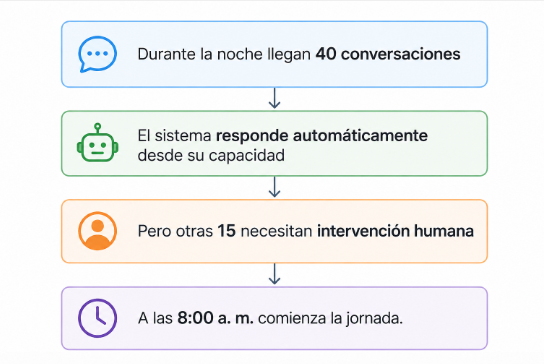
| Automation + multi-agent team |
Complex inquiries | Human agents + automation as a filter |
Customers in different countries | Automation + human team |
Many inquiries outside business hours | AI/chatbot + human escalation |
Critical operation | 24/7 human coverage + automation |
The real challenge: what happens to conversations when the team arrives?
Here’s a hypothetical case that could happen in your company:
- Who receives those 15 conversations?
- Do you know which one is urgent?
- Do you know what the automation system replied?
- Does the customer have to explain their problem again?
- Can you tell how long they’ve been waiting?
- Is there someone responsible for each conversation?
Here, 24/7 service stops being just a problem of availability and becomes an issue of organization and continuity. Because it’s not very effective to respond automatically at night if, when the workday starts, conversations are disorganized or no one knows who should follow up on each case.
How to organize a 24/7 service operation
Before implementing any tool, it’s best to define a process.
1. Identify the most frequent inquiries
Review your company’s actual conversations to know what customers ask most often.
2. Classify the inquiries
For example:
- Frequently asked questions.
- Sales.
- Support.
- Payments.
- Orders.
- Complaints.
- Urgent requests.
3. Decide what can be automated and what should be handled by people
4. Define what should be escalated
5. Assign responsibilities
6. Measure performance
It’s helpful to track indicators like:
- First response time.
- Conversations handled.
- Pending conversations.
- Volume by channel.
- Inquiries resolved automatically.
- Conversations escalated to agents.
- Resolution time.
- Performance by agent.
7. Review and make decisions for operational improvements
Data should be used to identify problems and make decisions.
If certain inquiries keep coming up, you need to keep public information updated, improve an automated flow, modify an internal process, or train the team.
What role does WhatsApp 24/7 support play?
For many companies, WhatsApp is one of the main communication channels with their customers. However, using WhatsApp for support doesn’t just mean having a number and replying to messages. As chat volume grows, you need to consider other aspects such as:
- Several agents handling the same conversations.
- Some messages may go unanswered.
- Agents may lose context.
- It’s hard to know who handled each conversation.
- Conversations can pile up outside business hours.
- The company may have little visibility over response times.
For this reason, when WhatsApp becomes a key sales or support channel, it also needs an operational structure. In this case, the Official WhatsApp API lets you integrate technology tools like bots, artificial intelligence, CRM, and other solutions that help structure business conversation management.
24/7 service goes beyond just integrating a chatbot
Before choosing a tool, you should analyze the times when customers write the most, what they ask, which inquiries are repetitive, and which truly require a person.
From there, you can choose and build a model that combines technology and human teams according to your company’s real needs. Because the goal of a 24/7 strategy shouldn’t simply be to “respond at any hour”, but to be available when the customer needs you, respond correctly, and make sure no important conversation gets lost along the way.
When WhatsApp, Instagram, Facebook, or other channels together generate a significant volume of conversations, having a platform that centralizes them, distributes them among agents, automates part of the service, and measures operations can help reduce many of the problems that arise as a company grows.
Can Callbell help provide 24/7 service?
Yes, and it’s important to understand which part of the problem a platform like Callbell solves.
Its main function is to help structure the management of digital conversations through an omnichannel platform and digital channels like Instagram, TikTok, Facebook and WhatsApp.
It also offers automation tools through chatbots, AI Agents, metrics, and features to distribute and organize conversations. This can be especially useful when a company combines automation + human support.
This is where a platform like Callbell can become an ally to structure your operation: centralizing conversations, distributing chats among agents, automating inquiries, incorporating artificial intelligence, and providing metrics to help you understand what’s happening with your support.
Is your company ready to respond when your customers write?
Centralize WhatsApp, Instagram, Facebook, and other channels in one place, combine automation with human support, and keep control of every conversation—even when your team isn’t available.
See how Callbell can help you organize and scale your company’s support.

About the author: Hello! I am Alan and I am the marketing manager at Callbell, the first communication platform designed to help sales and support teams to collaborate and communicate with customers through direct messaging applications such as WhatsApp, Messenger, Telegram and Instagram Direct