Indice
When a customer messages a company's WhatsApp Business to make any type of inquiry, it is crucial to know how to train an AI agent so it can respond within seconds with the right tone and excellent writing. However, in some operations, a serious problem arises: the information provided is completely wrong and does not exist in the catalog, or the agent fails to answer correctly.
When a virtual assistant does not have the exact information at hand, it does not act out of ignorance. Due to the way this model operates, the agent tries to guess and fills the gap with the answer it considers most likely. This improvisation causes operational failures in customer service, leading the business to promise non-existent costs, give incorrect schedules, or lose sales opportunities by providing wrong information. The good news is that solving this issue does not require programmers or complex technical processes.
The key is to review what information the system receives, how it is organized, and what its limits are. This article covers important aspects to train an AI agent correctly, using real company data.
“Training an AI Agent" Doesn't Mean What Most People Think
When a company decides to train an AI agent, it usually imagines a process similar to training a new employee: showing them documents, correcting them, and repeating until they learn the information. However, with current Artificial Intelligence systems, that method is inefficient and unnecessary.
There are two options:
- Modify the system's internal programming: This involves changing the original code to record the company's information. This method is more expensive, takes more time, requires a team of programmers, and must be repeated from scratch every time a price or product changes.
- Connect the tool to a folder of documents: Instead of reprogramming the system, you can give the AI Agent access to a database with catalogs, FAQs, and current policies. Before answering a chat, the tool searches for the exact data in that folder and replies using that information as a reference. This method updates instantly by simply changing a file and does not require programming knowledge.
For the daily operations of a support and sales team, connecting the system to a folder of documents is the most efficient strategy. Although updating an assistant's files is a simple process for cases such as price changes, schedules, or new products, it is essential that when training an AI agent you provide the correct information, at the right time, and with clear limits on what it can and cannot answer.
Why an AI Agent Improvises (And Why It's Almost Never the Tool's Fault)
It is essential to understand the root of the problem, as each failure has an operational cause:
- Lack of information: When the system does not have the exact data in its reference base, it generates a generic text or lets the conversation go cold.
- Outdated documents: This happens when prices and schedules change, business policies need to be modified, but the tool continues to consult old files.
- Lack of instructions for complex questions: The system does not have the exact instruction on when it does not know an answer and does not know when to transfer the chat to a human advisor, so it tries to give a solution or simply does not intervene properly.
- Insufficient supervision: Chat histories are not reviewed and there are no performance indicators, so procedures that need correction are not detected in time.
None of these issues are solved by asking the system to change its behavior on its own. When training an AI agent, inaccuracies are corrected by establishing clear processes, structuring company data, and maintaining ongoing control over its responses.
The 4 Pillars for Properly Training an AI Agent
1. Audit and Centralize Real Information
The first step is to make a detailed inventory of the sources where the company's official knowledge is stored. Many companies discover that there is information they had not previously considered. Before connecting the platform, it is essential to review and update the following resources:
- Product or service catalog with current prices.
- Actual frequently asked questions (For this, team participation is essential because they know what they are).
- Return, warranty, exchange, shipping, and payment method policies.
- Procedure manuals and customer service protocols. What, when, and how to answer.
- History of successful conversations (What answers worked with real customers to give the AI agent a base)
A practical exercise is to ask the service team to make a list of the 20 most frequent customer inquiries. This initial resource represents the priority knowledge base to successfully train an AI agent from the start.
2. Structure Knowledge to Be Easily Findable
Having official documentation is not enough if it is accumulated in lengthy, disorganized files. These base documents are ideal when information and content are organized into short, specific fragments aimed at answering a particular inquiry.
Good organizational practices:
- Divide long files into individual sections, assigning a technical sheet for each product or a policy for each service module.
- Include precise titles to guide the tool's search and make internal audits easier for supervisors.
- Eliminate contradictions between files. If a catalog is updated, the website should be updated as well.
- Appoint someone responsible for updating the information.
3. Clearly Define What the Agent Can (And Cannot) Answer
An efficient system is not characterized by answering any request, but by accurately recognizing its scope. Setting boundaries for queries is just as important as loading the company's database.
To ensure safe operation, it is advisable to structure support according to the following guidelines:
- Topics to automate: Inquiries about the product catalog, current rates, inventory availability, service policies, order tracking or status, and appointment scheduling.
- Cases to transfer to an advisor: Complex complaints, special negotiations, legal procedures, and situations of dissatisfaction or crisis.
- What to do when it doesn't have the answer: When the tool does not have the exact data, it should openly admit it and transfer the conversation to human staff, providing the full history of the interaction to ensure continuity.
Defining these aspects does not limit interaction; on the contrary, it makes a difference when training an AI agent. Users do not expect a virtual tool to solve every scenario, but they do expect accuracy and the option to contact a human representative when needed.
4. Measure, Correct, and Continuously Improve
The process of training an AI agent does not end with the initial setup; it is a process of continuous improvement. Organizations that achieve the best results manage the performance of their virtual assistants through constant supervision and feedback.
Some key practices to optimize operations:
- Periodically review a sample of real conversations to detect information gaps or inaccurate answers.
- Define concrete metrics: Correct response rate, escalation rate to human agents, first response time, customer satisfaction.
- Update files whenever a price, policy, or product changes to prevent customers from receiving incorrect information.
- When possible, show the source of each answer to be able to audit where the information came from.
Errors That Ruin Good Agent Training (Important)
Even with the best intentions, many companies make the same mistakes when deploying their first virtual assistant:
- Giving access to sensitive information: Connecting the agent to the entire company database, including financial information or internal client notes, exposes sensitive data.
- Uploading outdated documentation "just to have something quickly" and never reviewing or updating the information again.
- Not defining a protocol for escalation to humans, which forces the agent to "guess" in situations it cannot handle
- Confusing tone personalization with content accuracy: An agent can sound perfect and still provide incorrect information if its knowledge base is not well implemented.
- Not measuring anything: Without metrics, it is impossible to know if the agent is improving or getting worse over time.
Avoiding these mistakes is an important step to train an AI agent, ensuring that automation protects the company's reputation and improves the user experience.
A Practical Case: What This Looks Like in WhatsApp Customer Service
A case in the retail sector that handles the main volume of its inquiries through WhatsApp clearly illustrates the workflow. Before activating automation, the company takes three actions: Updates its commercial catalog, documents the most frequently asked questions, and identifies cases that should be transferred directly to staff (such as complaints or special requests).
With this preliminary work, the organization connects the AI to the Official WhatsApp API. The agent answers questions about prices, schedules, and availability by exclusively consulting the database. When a customer asks a question outside that scope, the tool recognizes the situation and transfers it to the team with the conversation context, so the user does not have to repeat their request.
This is the model being adopted by companies automating their service: Instead of replacing human staff, they free them from repetitive inquiries so they can focus on cases that require specialized judgment.
Optimize Customer Service with Callbell's AI Agent
Transforming repetitive WhatsApp inquiries into smooth, accurate conversations without information errors requires the right strategy and technology. By training an AI agent with real business data, the sales and support team will free up operational time to focus on closing sales and solving complex cases.
Callbell allows you to connect a virtual agent trained with your company's own catalogs, policies, and FAQs, ensuring accurate answers at all times and transferring chats to human staff when needed.
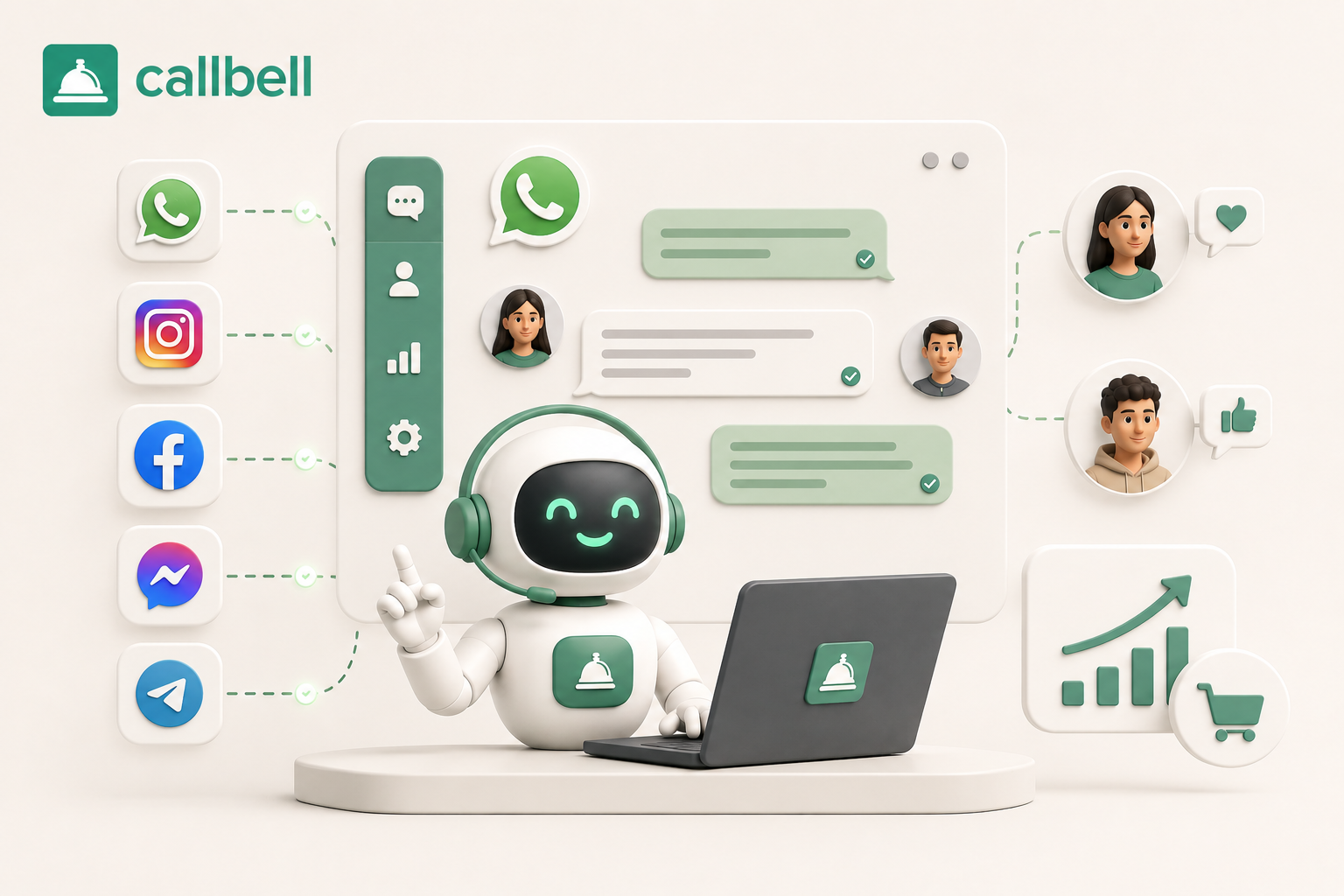
Solutions like Callbell's AI agent are designed for this hybrid environment within WhatsApp Business and other digital channels such as Facebook, TikTok, Instagram, and Telegram. The platform uses the business's official information: catalogs, policies, and service guides, and transfers conversations to the team at the right time. It does not require programmers or much time spent training staff to understand how it works.
Take the step towards automated and professional messaging support. Schedule a demo today with the Callbell team.

About the author: Hello! I am Alan and I am the marketing manager at Callbell, the first communication platform designed to help sales and support teams to collaborate and communicate with customers through direct messaging applications such as WhatsApp, Messenger, Telegram and Instagram Direct