Indice
Finding a system to automatically respond to WhatsApp may seem simple until a company compares the different alternatives available. Not all solutions automate conversations in the same way: Some allow you to send predefined messages, others work through rules and buttons, and some use artificial intelligence to interpret questions and respond according to the context of each conversation.
The choice depends on the level of automation your operation needs, the volume of conversations, and what you expect to happen after a message arrives.
This article explains what a system for automatically responding to WhatsApp is, its main categories, what each can do, and what aspects to consider before choosing a solution. It also discusses when it may be appropriate to use an AI Agent and what features a more complete customer service platform should have.
What is a system for automatically responding to WhatsApp?
A system for automatically responding to WhatsApp is a tool that streamlines communication with customers through automatic responses or actions, avoiding the need for a person to manually intervene in every conversation. This can be useful for simple situations such as sending a welcome message, providing business hours and locations, confirming a reservation, or notifying that the team is outside business hours.
However, just because different tools have the same goal—to automate—does not mean they work the same way or are suitable for the same operations. Depending on the tool, automation can work through:
- Predefined automatic messages
- Rules and conditions
- Buttons and menus
- Chatbots
- Artificial Intelligence
- Automatic transfer to human agents.
That’s why, before choosing a platform, it’s important to identify what type of conversations your company needs to automate.
Some tools specialize in a single level of automation: basic responses, predefined flows, or artificial intelligence. Others allow you to combine different levels within the same operation. Callbell, for example, integrates these different possibilities within a single platform, allowing you to combine the 3 main categories.
3 Main Categories of a System for Automatically Responding to WhatsApp
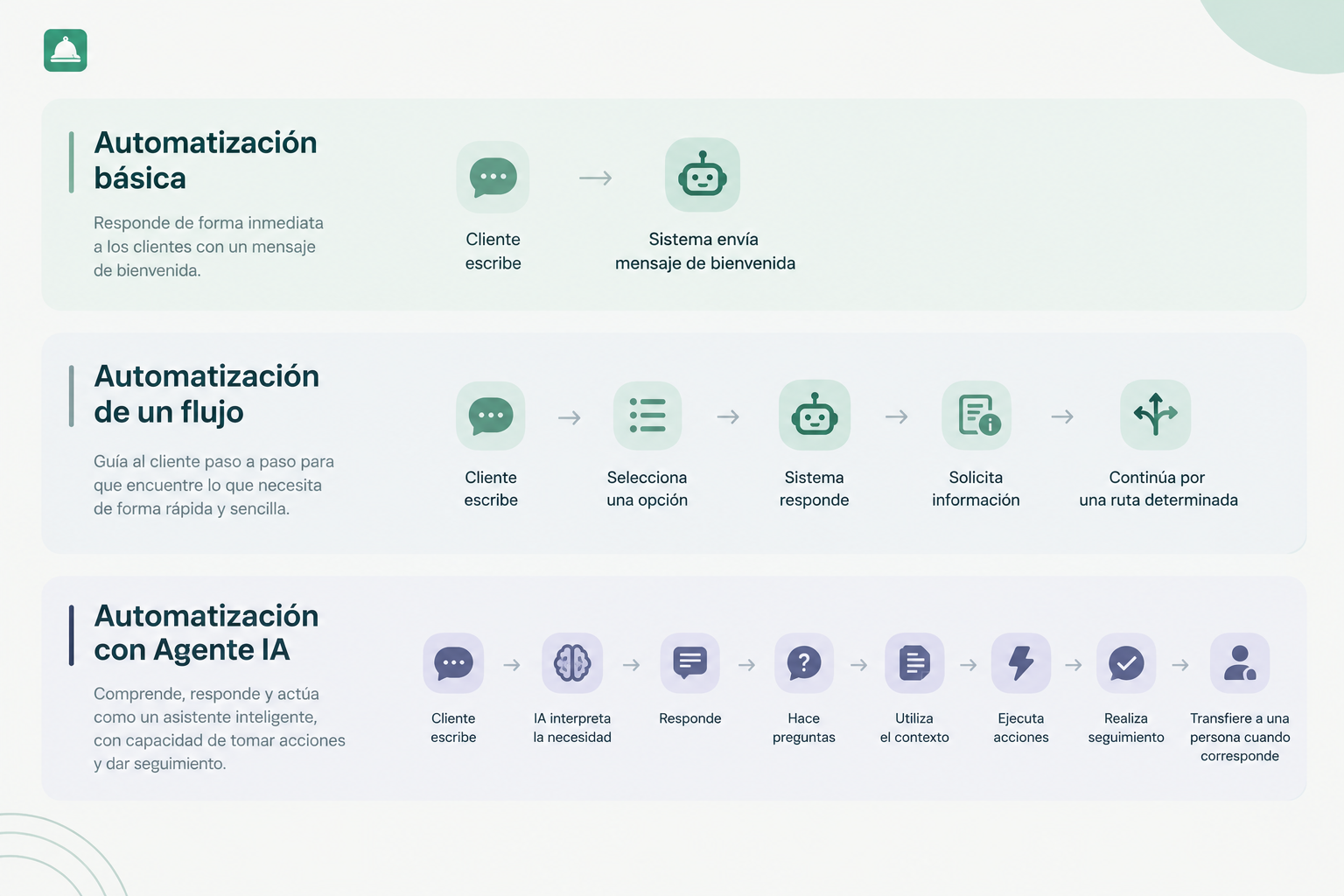
Although there are different types of tools on the market, three major levels of automation for WhatsApp can be identified.
Category 1: WhatsApp Business Automatic Replies
This is the most basic level because it uses the features already included in WhatsApp Business. However, being a simple alternative does not mean it lacks usefulness. Its main functions include:
- Welcome message: can be sent when a customer starts a conversation.
- Out of office message: lets you inform that the business is outside of normal hours.
- Quick replies: allow you to use shortcuts to answer frequently asked questions with pre-prepared messages.
For a small business that receives few conversations, these features may be enough to reduce some repetitive tasks. However, when the volume of messages increases or conversations require different paths, these features start to fall short.
Category 2: Chatbots and Rule-Based Flows
The second category consists of platforms that allow you to build conversation flows, menus, conditions, and automatic actions. The operation can be represented simply as:
Customer option → condition → response → next step
This is the classic model: “Press 1 for sales, 2 for support, or 3 for business hours.”
This type of automation works especially well when companies receive repetitive and predictable inquiries. For example:
Sales → show commercial information.
Support → request order number.
Business hours → show hours.
Talk to an advisor → transfer the conversation.
However, it has an important limitation: it depends on the paths and conditions that have been previously configured. If the customer has a need that does not match the available options, the flow may not have an appropriate response.
Therefore, rule-based chatbots work especially well for structured processes and predictable inquiries, but may be less flexible when conversations are highly varied.
Category 3: AI Agents for WhatsApp
A system for automatically responding to WhatsApp based on Artificial Intelligence does not depend on a fixed menu of options or robotic responses, but rather understands the real intent behind each message. An AI Agent can read a question, assist the customer if they change the subject, remember what the customer said before, and continue to understand the context—something a chatbot cannot do.
This is what differentiates an AI Agent from automation based exclusively on rules: The conversation does not always have to depend on the customer selecting exactly one of the predefined options. This allows for less rigid conversations than those that depend solely on menus.
Additionally, it allows you to automate part of the service during hours when no staff is available, as long as the necessary information and conditions to respond have been previously configured.
What can an AI Agent do on WhatsApp?
Depending on its configuration and the tools it is connected to, an AI Agent can be used to:
- Answer frequently asked questions
- Explain products or services
- Collect customer information
- Qualify leads
- Guide purchase processes
- Offer options via buttons
- Do follow-ups
- Identify when a conversation needs human intervention
- Transfer conversations to agents
- Handle conversations outside of normal hours.
Artificial intelligence, therefore, does not have to be used only to answer questions. It can also be part of a broader customer service or sales journey.
What is the difference between automating responses and automating a conversation?
Automatically responding does not mean automating an entire conversation.
An automatic response can simply send a message when a certain condition occurs. Automating a conversation means something more: Interpreting the request, determining what information the customer needs, offering options, moving through different paths, doing follow-ups, and defining when a person should intervene.
For example:
That’s why, when evaluating a system for automatically responding to WhatsApp, it’s not enough to check if it can send messages without human intervention. You should also analyze what it can do after sending the first response.
Quick Comparison of the Three Categories
Native WhatsApp Features | Chatbot with Flows and Menus | AI Agent | |
Understands freely written questions | No | Limited | Yes |
Requires fixed option menus | Not applicable | Yes | No |
Connects with real business information | No | Partial | Yes |
Ideal for | Very small businesses, low volume | Repetitive and predictable inquiries | Customer service and sales with medium or high volume |
Level of initial setup | None | Medium | Medium-high, but with better long-term results |
The table shows that more automation does not always mean a company needs a more complex solution. The choice should depend on the type of conversation and the volume of the operation.
Which system to choose to automatically respond to WhatsApp?
There are different alternatives on the market depending on the category, and the answer depends on the needs of each operation.
- For businesses looking for an integrated AI Agent for customer service and sales: Callbell is one of the platforms that offers this category within a single shared WhatsApp inbox. Its AI Agent is trained to understand customer questions, connects with real business information, and knows when to transfer the conversation to a team member with all the context already summarized. And if you need a hybrid connection between bots and AI Agent, Callbell also allows it.
There are other platforms on the market with a similar AI Agent approach, and each business should evaluate which best fits its conversation volume, budget, and process complexity. The important thing, beyond the specific provider, is to understand what level of automation the company is at today and where it needs to go.
What should a good system for automatically responding to WhatsApp have?
Automating responses is only part of WhatsApp customer service. Before choosing a platform, it’s worth reviewing what happens before, during, and after the automatic response.
1. Automatic responses
The system should allow you to quickly respond to the most frequent inquiries and set messages for certain moments or situations.
2. Conversation flows
When a conversation has different possible paths, flows allow you to define what should happen after each response.
3. AI Agent
When questions do not follow a fixed structure, an AI Agent can interpret natural language and respond using the company’s available information.
4. Buttons and options
Buttons allow the customer to select an alternative instead of having to type each response.
For example: What do you need?
[Buy] [Product inquiry] [Support]
This can make certain journeys faster and more predictable.
5. Follow-ups and reminders
A conversation does not always end because the customer received a response.
It may happen that someone asks about a product, receives information, and stops responding.
In those cases, a platform can allow you to set up automatic follow-ups to resume the conversation.
6. Transfer to a human agent
An automation system should also consider the moment when AI is no longer the right option. For example, when:
- The customer requests to speak with a person
- The case is too complex
- There is a negotiation
- A problem arises that requires intervention
- There is a business opportunity that should be handled by a salesperson.
In Callbell, AI Agents can be configured to automatically transfer the conversation if the customer requests it, when complexity is imminent, or when a sales opportunity requires direct intervention.
7. Multi-agent management
It’s also necessary to know who will handle each conversation: whether it was someone from the team, the bot, or the AI agent.
A multi-agent platform can distribute chats among different team members and allow everyone to work from the same inbox.
8. History and context
The history allows agents to know what happened before intervening.
This is especially important when a conversation starts with automation and then moves to a person.
9. Metrics
The company should also be able to know what’s happening with the conversations:
- Chat volume
- Response times
- Conversations handled
- Team performance
- Automation results.
Without measurement, it’s difficult to determine if automation is really improving the operation.
How to choose the right system for each type of business
Before deciding on a system for automatically responding to WhatsApp, it’s worth answering some simple questions that depend on the activity and operational flow in each company:
- How many conversations are received per day? A low volume can be solved with WhatsApp’s native features. Whereas a medium or high volume almost always needs something more advanced.
- How much do customer questions vary? If the same five or six questions are asked daily, a chatbot and a menu list may be enough. But if they vary a lot, an AI Agent delivers better results.
- How often do processes change? Products, prices, hours, policies, and processes can change. That’s why any automation solution requires mechanisms to keep the information it uses to respond up to date. Flow-based chatbots usually require manual modifications when the configured journey changes. AI Agents also need updated information and proper setup to respond correctly.
- Is real-time information needed? If so, a bot can connect with an inventory or logistics system, just like an AI agent. However, if more details about the order are needed, integrating the agent may be more ideal.
- What is the budget to invest in a more complete platform? For more advanced tools, a bit more investment is needed, but the return is significant and much more reliable.
Can Callbell work as a system for automatically responding to WhatsApp?
Callbell brings together different levels of automation and conversation management within a single platform. The solution allows you to centralize WhatsApp conversations along with other messaging channels, work with a multi-agent inbox, and incorporate automation tools and AI Agents.
The advantage of combining these features is that automation does not have to completely replace the team. It can be used to handle repetitive interactions and organize those that require human intervention.
Conclusion
Choosing a system for automatically responding to WhatsApp is not just about looking for a tool that sends messages without human intervention. The decision should be based on the type of conversation that needs to be automated.
In this last scenario, solutions like Callbell allow you to combine WhatsApp, automation, AI Agents, multi-agent management, and other messaging channels within a single platform. In this way, the choice of a system for automatically responding to WhatsApp is based on the real needs of the operation and not just on the number of features a platform offers.

About the author: Hello! I am Alan and I am the marketing manager at Callbell, the first communication platform designed to help sales and support teams to collaborate and communicate with customers through direct messaging applications such as WhatsApp, Messenger, Telegram and Instagram Direct