Indice
Artificial intelligence can automate customer service tasks, sales, follow-ups, information classification, data analysis, and other repetitive activities. But knowing what can be automated with AI in a company is not just about making a list of everything a tool can execute. The most useful question for a company is: What is the team doing today in a repetitive or manual way that could be solved differently?
In theory, almost any process that involves digital information can incorporate some level of automation. But that doesn’t mean all of them need artificial intelligence. Some tasks are better solved with a simple rule, others with an automated flow, and others do require an AI agent capable of interpreting what a person writes and deciding how to continue the conversation.
That’s why this article is organized by real problems that almost any company will recognize immediately, and for each one, it explains what artificial intelligence can specifically solve to help identify what can be automated with AI in the company.
What Can Be Automated with AI in a Company?
AI can automate any part of a process that involves interpreting information, classifying requests, generating responses, following up, analyzing data, or executing actions based on certain conditions. Processes that can be automated include:
- Personalized responses to frequent or complex questions.
- Classifying requests and inquiries.
- Qualifying leads.
- Following up on conversations.
- Assigning requests to the corresponding team.
- Searching for and summarizing information.
- Analyzing large volumes of data.
- Detecting patterns or inconsistencies.
- Generating reports.
- Collecting customer information.
- Triggering reminders.
- Guiding sales or support conversations.
However, there is an important difference between automating a task and automating an entire process.
A rule-based automation may be enough when conditions are clear. AI adds real value when it interprets natural language, classifies variable information, understands a request written in different ways, or maintains a fluid conversation based on context.
That’s why, before choosing an AI tool, it’s best to identify which part of the process should be automated and which part should continue to depend on the team.
How to Know if a Process Is a Good Candidate for Automation?
Not all company processes are equally suitable to automate with AI. The following characteristics make them worth reviewing:
- It is frequently repeated, the team spends time doing the same task over and over.
- It follows an identifiable logic, with conditions or criteria that allow you to determine what to do.
- It handles a considerable volume, even if each task is simple, their accumulation creates a significant workload.
- It is prone to human error, due to fatigue, forgetfulness, or distraction
- It delays other activities, the team spends operational time on a task that doesn’t necessarily require human intervention.
If a process meets most of these characteristics, it’s a good starting point. In many cases, the best solution is to break it down: automate the repetitive parts and reserve human intervention for situations that require judgment, negotiation, empathy, or specialized knowledge.
“My team is overwhelmed and can’t handle all the chats”
- The real problem
This is probably the most common pain point among growing businesses that face the same types of questions repeatedly: price, availability, hours, payment methods. This causes the human team to end up spending their time on something completely repetitive instead of what really needs judgment.
- Which processes can be automated with AI
An AI Agent connected to WhatsApp or another support channel can answer those types of questions immediately, using real business information: catalogs, prices, policies. It can also ask qualifying questions before passing the case to a person. Additionally, it can summarize the conversation context so that when an advisor intervenes, they don’t have to start from scratch.
- What shouldn’t be automated right away?
Conversations involving a delicate complaint, a special negotiation, or a situation where the customer is frustrated still need human judgment. A well-configured agent should recognize these cases and transfer them, not try to solve them at all costs, because it could provide incorrect information or lose a sale that a human could have closed. Automation should know when to continue and when to step aside.
"Orders get mixed up with actual inventory and end up selling what’s not in stock"
- The real problem
When inventory is in one system and sales are generated in another—physical store, digital channel, or WhatsApp—it’s very common for the information to be unsynchronized or outdated. The result is a customer who is confirmed something that later cannot be delivered.
- What can be automated with AI
Connecting inventory with sales channels allows any availability inquiry to be answered with real, up-to-date data, without relying on someone manually checking a spreadsheet. Such a system can also alert when a product is about to run out, before it becomes a customer problem. An omnichannel platform that integrates an AI Agent helps maintain this synchronization without anyone having to do it manually.
- What shouldn’t be automated yet
Decisions about restocking products with unpredictable high demand still need human review: AI can suggest patterns, but a person with business context still makes better decisions in those specific cases.
"Billing is delayed because someone has to manually consolidate everything"
- The real problem
In many companies, billing is still a manual process: someone reviews orders, cross-checks information, generates the document, and sends it. As volume grows, errors and delays grow with it.
- What can be automated with AI
Automatic extraction and classification of data from invoices, orders, and receipts is one of the AI applications with the best effort-to-result ratio, precisely because it works with information already in the system and follows a clear structure. This allows you to generate invoices, reconcile payments, and detect inconsistencies without a person having to review each document one by one, avoiding operational errors and sending the wrong documents.
- What shouldn’t be automated yet
Cases with accounting exceptions, special discounts, or conditions negotiated outside the norm should still be reviewed manually, at least until the automated process has been proven error-free for some time.
"The team loses sales opportunities because they can’t respond in time"
- The real problem
A lead who doesn’t get a quick response loses interest or goes to the competition. When the sales team has to handle a high volume of conversations manually, it’s almost impossible to follow up in time.
- Which processes can be automated with AI
AI can help identify the contact’s intent, collect information, qualify opportunities, and determine which conversations need follow-up. Automation allows the team to receive conversations with more context and spend more time on opportunities that truly need commercial intervention.
- What shouldn’t be automated yet
Negotiations, high-value closings, commercial exceptions, and conversations where there is a significant opportunity still benefit from human intervention. AI can better prepare an opportunity. It doesn’t necessarily have to close every deal.
"Marketing produces content and reports, but no one has time to analyze the results"
- The real problem
It’s common for a marketing team to generate more content and campaigns than they can analyze in detail. Things are published, reported, but rarely is that analysis used to adjust strategy in time.
- What can be automated with AI
Automatic report generation, audience segmentation based on real behavior, and detecting which type of content is working best are tasks where AI can save a huge amount of operational time, leaving the human team with more space to focus on strategy instead of data collection.
- What shouldn’t be automated yet
The creative part and brand voice still need human judgment. AI can generate a first draft or proposal, but the final decision on what truly represents the brand should not be fully delegated.
"The data exists, but no one uses it"
- The real problem
Almost every company generates data all the time: in sales, customer service, marketing. But in most cases, that data is scattered or reviewed too late to change anything.
- What can be automated with AI
Automatically cross-referencing information from different sources and generating alerts or summaries allows decisions to be made with current data, not last month’s report. According to several recent studies on AI adoption in companies, this is one of the areas where the most value is concentrated, along with customer service and sales.
- What shouldn’t be automated yet
Strategic business decisions such as entering a new market, changing suppliers, investing in a product line, can be supported by AI-processed data, but the decision itself remains a human responsibility.
What AI Should Not Automate Yet in Processes
There are three specific patterns where AI may fall short, and understanding each with real examples is what truly helps decide what to automate and what not to.
1- Ambiguous situations, where there isn’t a single correct answer
AI automates well what has a clear answer: yes or no, fixed prices, established hours, inventory based on real data. However, it falls short when the situation doesn’t have a single correct answer, but depends on more personalized negotiations or specific situations.
A system may have a discount policy configured, but it can’t decide when it makes sense to apply that policy because the situation warrants it. That ability to make a justified exception, knowing why it’s being made, remains deeply human.
2- Decisions with legal or ethical weight
There are decisions that, if they go wrong, don’t just create a bad experience: they create liability for the company. Approving a return outside established terms, accepting a special condition in a contract, or responding with something that could be interpreted as a formal company promise are examples. It’s not that AI can’t draft a reasonable response in these cases, it’s that no one should be willing to let a response with legal consequences go out without a person reviewing it first.
The practical way to handle this is not to prohibit or block the AI agent from responding, but to train it to transfer the conversation with the appropriate context.
3- Moments when the customer needs to feel they’re talking to a person, not just getting a solution
This pattern is the easiest to overlook because it’s not about the difficulty of the question, but the emotional state of the person asking. A frustrated customer whose order arrives damaged doesn’t just want the problem solved, they want to feel that someone on the other side understood their frustration. An automatic response, no matter how correct, can solve the problem and still leave the customer feeling the company didn’t care about what happened.
This doesn’t mean AI can’t participate at all in those conversations. It can, for example, recognize frustration signals in the message and transfer immediately, instead of trying to resolve the complaint forcefully. The difference between a well-configured and a poorly-configured system at this point isn’t how smart it is, but how well it recognizes when it’s no longer appropriate to continue and should hand off to a human agent.
Can You Automate with AI Without Eliminating Human Intervention?
Yes, and in many business processes this can be the most useful alternative. A workflow can look like these 3 forms:
Automation doesn’t have to replace the entire process.
It can handle only the parts that are repeated, require speed, follow defined patterns, consume time, and don’t need human judgment.
Meanwhile, the team can focus on negotiating, resolving exceptions, handling complaints, making decisions, closing opportunities, and building relationships with customers.
The most useful automation isn’t necessarily the one that eliminates the most human intervention, but the one that reserves that intervention for the moments when it truly adds value.
Does Everything That Can Be Automated Need Artificial Intelligence?
No. And understanding this difference is key to implementing automation efficiently. A company shouldn’t start by asking what AI tool it can buy. It should start by asking what it needs to solve.
Need 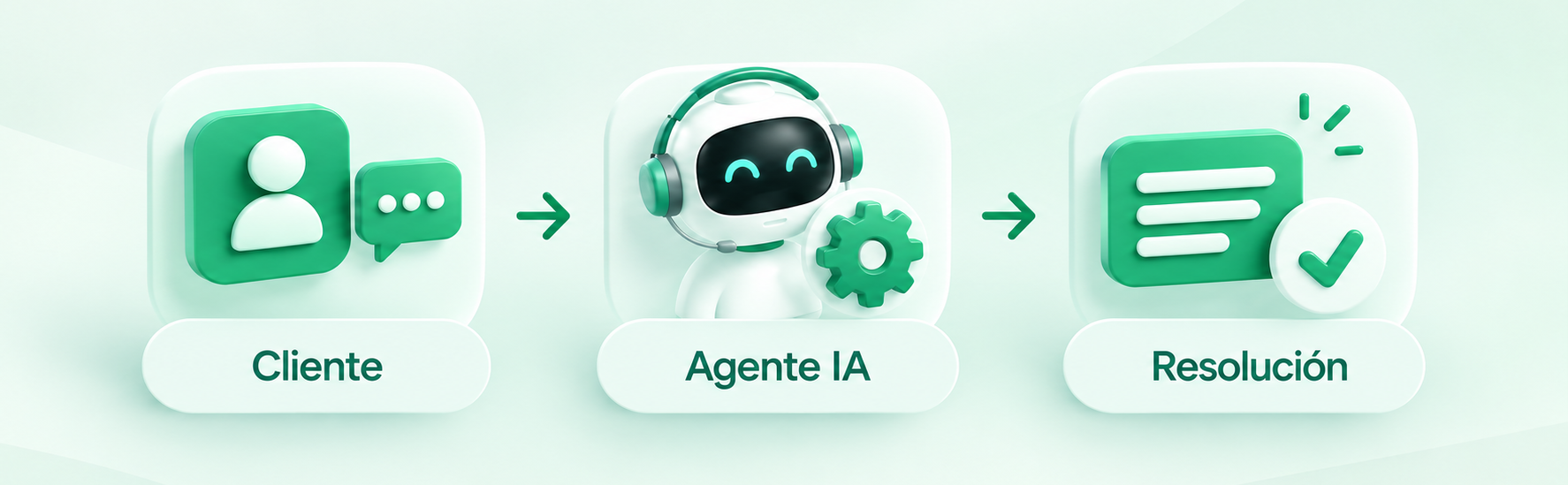
| Solution That May Be Enough 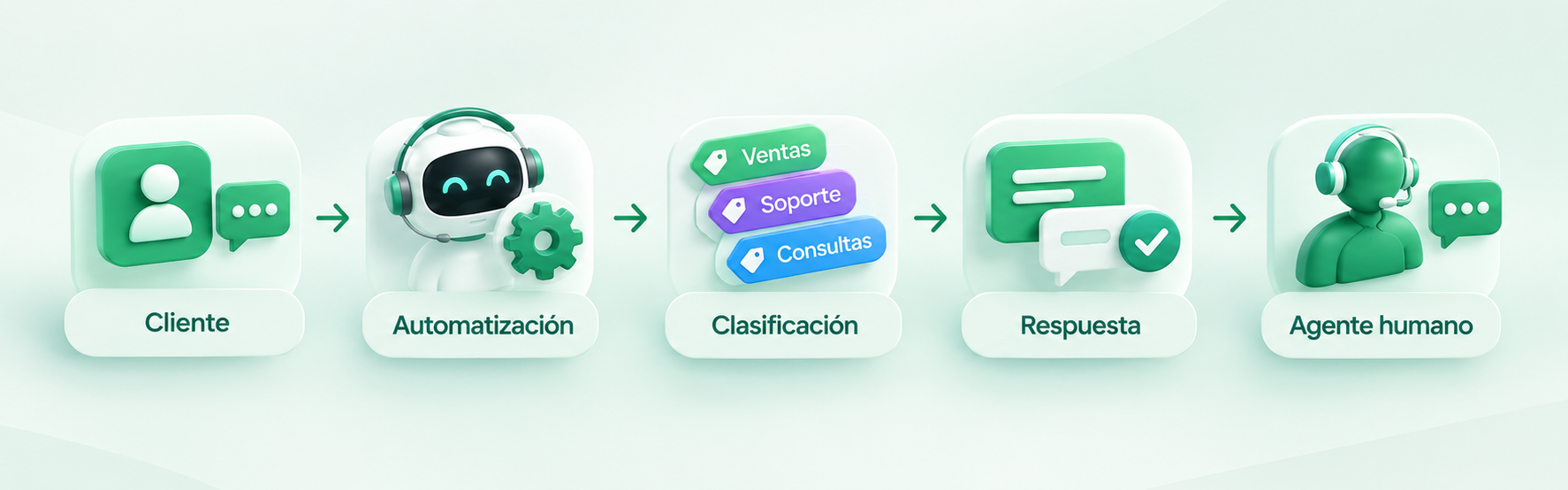
|
Always execute the same action 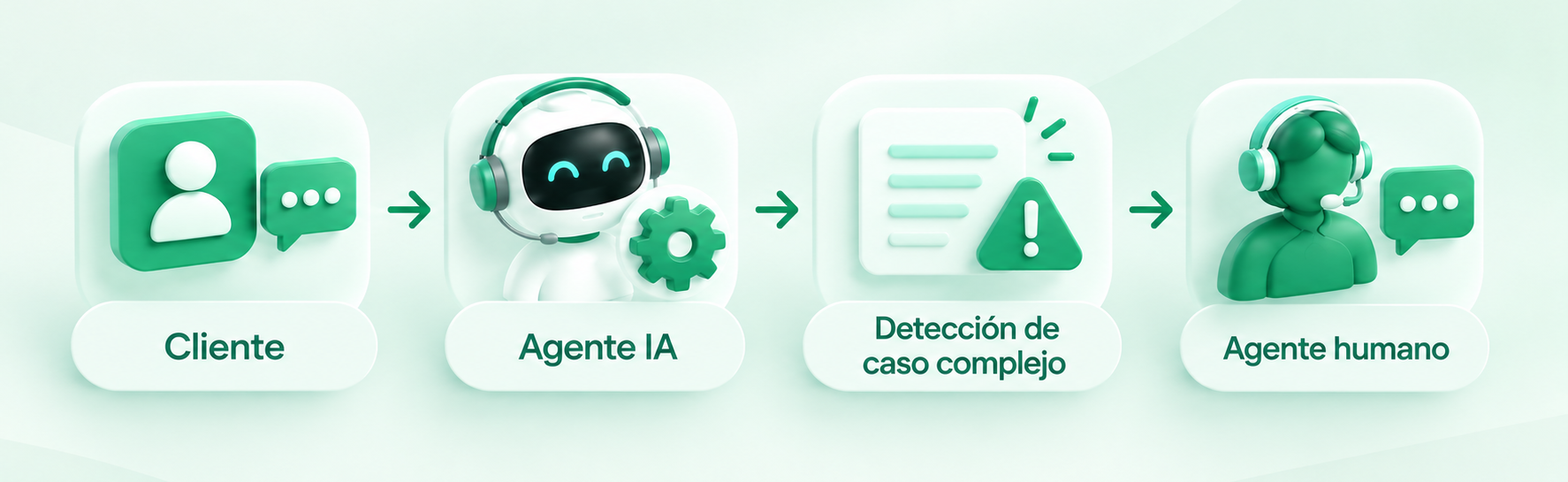
| Rule-based automation |
Present predefined options | Flow or chatbot |
Classify variable information | AI |
Interpret a freely worded question | AI |
Maintain an open conversation | AI Agent |
Solve a complex or sensitive case | AI + human intervention |
This difference matters because implementing a more complex technology than needed also creates problems: higher cost, more configuration, greater need for supervision, more difficulty controlling the process, and unnecessary dependence on a tool. The goal shouldn’t be to use more AI, but to use the right level of automation for each part of the process.
How to Know What Level of Automation a Company Has?
Before deciding what can be automated with AI, it’s best to understand the business’s starting point.
Manual level: Most of the process depends on a person doing tasks by hand, reviewing information, or transferring data between tools.
Partially automated level: There are already specific tools, such as automatic responses, basic chatbots, or some integrations, but they’re not necessarily connected to each other.
AI-driven level: Key processes incorporate automation and artificial intelligence, information flows with less manual intervention, and people can focus mainly on activities that require judgment.
Not all companies start from the same point. That’s why the level of automation should be determined by the real business operation, not by the latest tech trend.
How Can Callbell Help Automate These Processes?
Callbell allows you to combine different levels of automation within a platform focused on customer conversations.
Depending on the need, a company can use automations, flows, AI Agents, and human support within the same process.
Business Need | How It Can Be Addressed |
Repetitive questions | Automations and AI Agent |
Processes with defined steps | Flows and buttons |
Open questions | AI Agent |
Conversation follow-up | Reminders and automations |
Complex cases | Transfer to human agents |
High volume of conversations | Multi-agent support |
Information from different systems | Integrations |
Need to measure operations | Metrics |
The value is not simply in “adding AI” to conversations. It’s in being able to decide what gets automated, what is structured via a flow, and what should reach a person.
This approach allows automation to adapt to the process, instead of forcing all customers to receive exactly the same type of service.
Conclusion: Knowing What Can Be Automated with AI Starts by Detecting Where Time Is Lost
The question “what can be automated with AI?” has a much broader answer than a list of tasks. The opportunity lies in observing operations and detecting where friction is concentrated:
Where is work repeated? Where do requests pile up? At what point are customers waiting? Where are leads lost? What information is sent repeatedly?
Then comes a second decision: determine what level of technology each process needs. Some tasks can be solved with simple automations, others require structured flows, and those that involve interpreting conversations and responding in natural language can benefit from an AI Agent.
The goal, therefore, should not be to automate for the sake of automating. It should be to reduce people’s manual work where their creativity and strategy are not being utilized, improve response times, and allow people to intervene exactly where their judgment makes the difference.
For companies that focus much of their commercial and support operations on WhatsApp and other messaging channels, platforms like Callbell allow you to unify channels, areas, and agents in one place, and combine automations, flows, AI Agents, and human support.
Discover here how to bring AI automation to your company’s conversations.

About the author: Hello! I am Alan and I am the marketing manager at Callbell, the first communication platform designed to help sales and support teams to collaborate and communicate with customers through direct messaging applications such as WhatsApp, Messenger, Telegram and Instagram Direct